|
Index
| Trombone Ensembles
| CD's
| Manufacturers
| Jazz Styles
| Jazz Clubs
| Jazz
Festivals
| Trombone
News
| Comments
| Contact
|
||||
|
|
||||
|
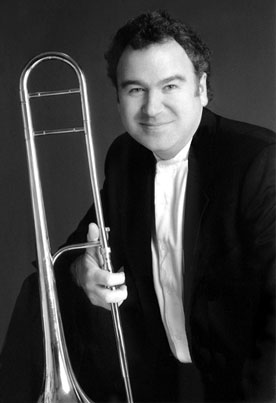
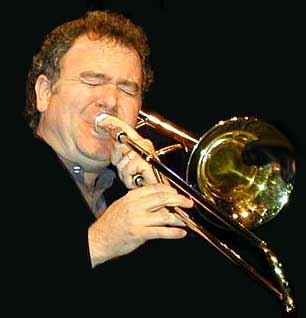
BOB
McCHESNEY Trombonist
Bob McChesney was born in Baltimore, Maryland in 1956, and began
studying the trombone at
the age of nine. McChesney holds a bachelor's Degree from the State
University of New York at Fredonia.
DOODLE
STUDIES AND ETUDES With Demonstration/Play-along CD by Bob McChesney Doodle Studies and Etudes by trombonist Bob McChesney was first published in 1992. For more than a thousand students and professional players it has proven to be an extremely valuable tool in improving fast legato skills on the trombone. Covering all aspects of the doodle tongue technique, this book was written for students, teachers and professionals alike. This complete method explains the fast legato technique in a step-by-step fashion, from how to correctly form the syllables to complex patterns incorporating natural downward slurs. - A
complete course of study in doodle tonguing A common
belief is that fast, clean legato playing is difficult to achieve
on trombone because the slide cannot be moved into position fast
enough. Actually, the issue of fast legato playing on trombone is
much more one of articulation than slide movement. Because there
are no valves or keys, the trombonist must articulate differently
than other wind players. In the doodle tongue technique, articulations
can be executed very fast, smoothly and evenly with each articulation
matching in sound, often making minor slide innacuracies unnoticeable.
Doodle tonguing is a multiple tongue technique used to facilitate smooth, fast legato playing on the slide trombone. Its main use has been in the performance of jazz and is employed by such notable trombonists as Bill Watrous and Carl Fontana. The technique is commonly called doodle tonguing because it uses syllables like those used when pronouncing the word doodle. (This method actually uses the syllables "da", "ul", and "la" to better convey the concept which is fully explained in Chapter One.) The broadest application of doodle tonguing is in jazz soloing, but it is also valuable in ensemble playing and in any situation where fast legato articulations are necessary. The technique is a powerful tool that will greatly expand the overall capabilities of the trombonist. Because it is a multiple tongue technique, doodle tonguing allows the player to articulate much faster than is possible with the single tongue. The technique also produces much smoother articulations than can be achieved with the standard multiple techniques of double and triple tonguing. In addition to its speed and smoothness, doodle tonguing lends itself perfectly to music played with a swing feel. Even when rhythmic patterns may be slow enough to single tongue, doodle tonguing can often be preferable because it easily produces swing. Many trombonists believe that doodle tonguing is performed using only a repetitive syllable pattern. Continuosly repeating a pattern of doodle syllables (referred to in this book simply as a basic doodle pattern) does allow for smoothness, definition and speed much of the time; however, when overtone changes on the trombone and/or rhythmic variations in the music are encountered, an alteration of the basic doodle pattern will yield a greater degree of clarity. While some players would use the basic doodle patterns excusively, regardless of the music, better overall clarity is obtained when the doodle patterns are altered to fit each musical situation. In Doodle Studies and Etudes, a complete system of articulation is presented in which the syllable chosen to articulate each note maximizes definition and jazz feel without loss of speed. The result is a variety of syllable combinations and patterns dependent upon both the rhythmic structure of the music and changes in the overtone series on the trombone. The system will be referred to in this method as "the doodle tongue technique". What you will learn in Doodle Studies and Etudes: 1) The four components of the doodle tongue technique and how to articulate them; 2) The application of the technique to a variety of rhythms; 3) The application of the technique to various melodic shapes, including upward and downward changes in the overtone series; 4) The combination of all of the above elements in the performance of jazz etudes. It is the author's opinion that the doodle tongue technique is essential for all of today's aspiring trombonists and it is the only technique that properly satisfies the current demand for faster legato playing. It is not intended to replace the standard methods of trombone articulation, but this technique will add a new dimension to the trombonist's performance. Once fully learned, the jazz trombonist could choose to combine this technique with single tonguing, double and triple tonguing, "against the grain" playing or any other articulations to make up an overall personal style of playing. This method should not be approached as a compilation of licks and jazz patterns that happen to work well on the trombone. Some patterns are used within the method as examples, but the doodle tongue technique can be applied to a far greater variety of music than could ever be contained in this or any book. Doodle Studies and Etudes is a complete course of study. It contains 141 exercises and ten etudes with recorded examples on cassette tape. It is my sincere belief that after its completion, the doodle tongue technique can be used for the benefit and enhancement of your playing. -
Bob McChesney Chapter
One - The Basic Components Chapter
Two - Slide Movement Between Syllables, Displaced
Accents Chapter
Three - Ascending Partial Changes, Pickups Chapter
Four - The Fourth Component, Descending Partial Changes Chapter
Five - Variations of the Doodle Pattern for Clarity in Downward
Partial Changes Chapter
Six - Successive Downward Partial Changes Chapter
Seven - Remaining Details of the Technique Etudes
©
1992 Chesapeake Music ----------------------------------------------------------------------------------------------
"Precisely
the exercises I would have a student do." ".
. . I highly recommend it to all serious students of the trombone."
"Bob
McChesney has successfully produced studies to make the jazz lover's
dreams come true. For a classical player like myself, this source
is terrific ..." "I
consider your book the definitive book on doodle tonguing for (at
least) three reasons: (1) you have the syllables figured out 'cold'
(2) the exercises are excellent, and (3) the etudes (heads) in the
back are also excellent! I like your demo tape and the etude tape
too!" ".
. . provides insights to doodle tonguing not currently found in
any other treatise." "It
works. After a week I'm playing things I never thought I would be
able to . . . a revolution for trombone players all over the world."
"McChesney
has codified the fast articulated style of 20th century jazz trombonists
such as Carl Fontana and Bill Watrous into a workable and concise
etude book with 'oodles of doodles' to practice on the trombone."
|
|